

If you are working in the IT industry and want a certification to prove your capabilities – or are aiming for the Japanese labor market – you have probably heard of the FE certification. But what exactly is FE, what do you study, and can you pass it starting from almost zero?
This article will answer everything. No fluff, just practical information and what you really need to know to get started.
1. What Is The FE Certificate?
FE– Fundamental Information Technology Engineer Examination (基本情報技術者試験) – is Japan's standard basic IT engineer certification. This is a national exam organized by IPA(Information-technology Promotion Agency) and officially recognized by the Japanese Ministry of Economy, Trade and Industry (METI).
The special thing about FE is: it doesn't matter where you studied or what degree you have. This certification solely evaluates your practical knowledge and skills in the IT field – including both theory and programming abilities.
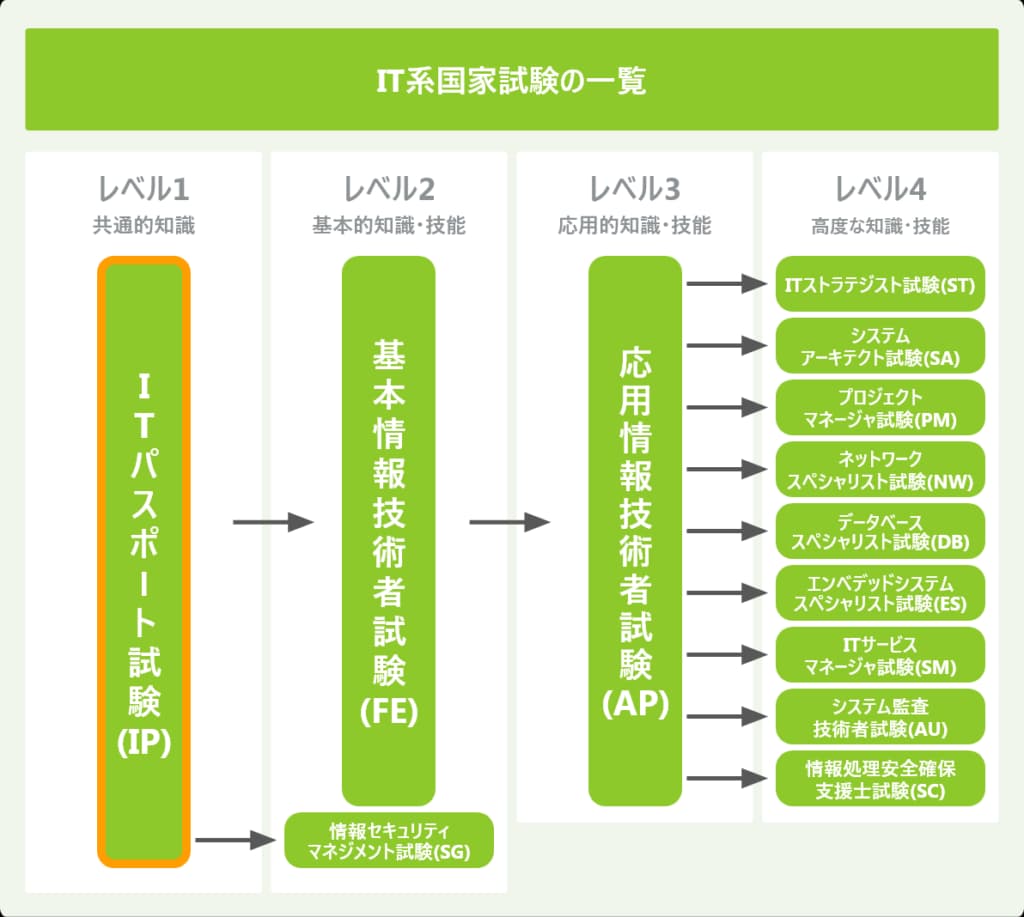
FE is at Level 2 in the Japanese IT Skill Standard (ITSS) scale. This is the next step after IT Passport (Level 1) and is the foundation to climb to higher levels such as AP, PM, or SC.
2. How Is FE Different From IT Passport?
Many people often ask: "I already have an IT Passport, is FE worth studying next?" The answer is: these two certifications are completely different in terms of target audience, difficulty, and content. Below is a comparison to help you easily visualize:
FE Certificate (Level 2)
- For engineers, developers, programmers
- Includes a practical skills section (afternoon exam)
- Requires algorithmic and programming thinking
- Pass rate is around 20–25%
- Can replace a university degree for a Japanese visa
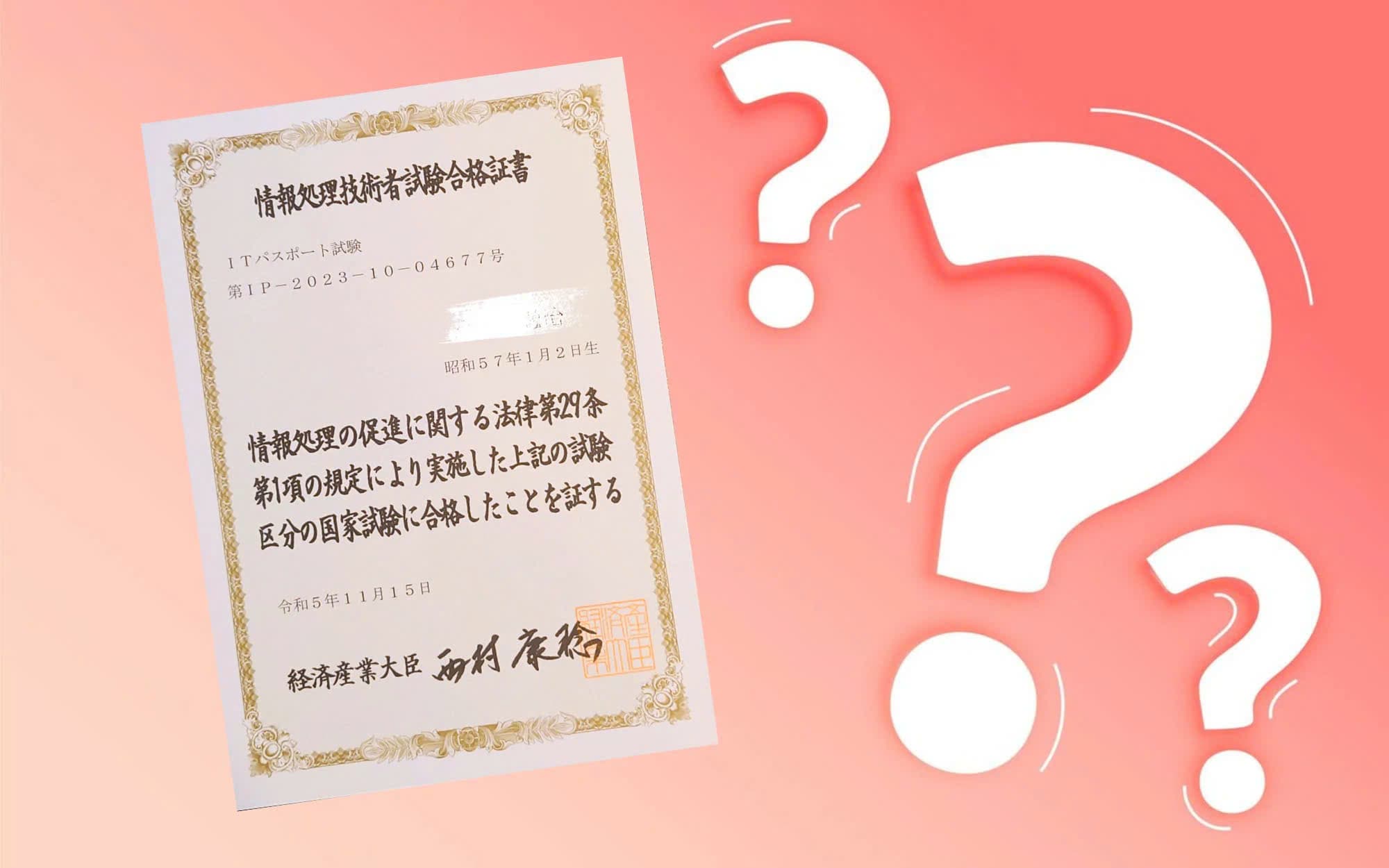
IT Passport (Level 1)
- For all audiences including non-IT
- Only includes a multiple-choice theory section
- General knowledge, management, strategy
- Pass rate is around 52%
- Cannot replace a university degree for a visa
In short: IT Passport is the "IT passport" to enter the industry, while FE is the "engineer ID card" to prove you can actually do the job. If you are a dev or want to become a professional engineer, FE is the true destination.
3. Detailed FE Exam Structure
This is the most asked part. Knowing the exam structure clearly will help you allocate your study time more wisely.
Morning Session – Theory
Duration: 150 minutes
Number of questions: 80 short multiple-choice questions
Points per question: 1.25 points
Passing criteria: Correct ≥ 48/80 questions (≥ 60 points)
Content: Comprehensive IT knowledge – hardware, networking, database, security, algorithms, project management, legal...
Afternoon Session – Skills
Duration: 150 minutes
Number of questions: 8 long questions, each with multiple sub-questions
Structure: Questions 1–5 are mandatory (12 pts/q), Question 6 is mandatory (20 pts), choose either Question 7 or 8 (20 pts)
Passing criteria: ≥ 60 points
Content: Programming (C/Java/Python/Assembly/Excel), algorithms, system design, practical security
Important: Both sections must meet their respective passing thresholds. If you pass one section, your result is reserved for the immediate next exam and you only need to retake the remaining section – this is a rather "friendly" point of FE compared to many other certifications.
Key knowledge areas to master
The scope of the FE exam is quite broad but mainly focuses on the following areas:
| Topic | Key focus areas |
|---|---|
| Basic Computer Science | Binary, number systems, logical operations, data structures (stack, queue, tree, hash) |
| Computer Architecture | RAM, CPU, scheduling algorithms (FIFO, LRU), cache memory |
| Computer Networks | TCP/IP, DNS, DHCP, NAT, common protocols |
| Databases | SQL, DB design, relations, normalization |
| Security | SQL injection, phishing, encryption, security policies |
| Software Development | Development lifecycle, testing (unit test, integration test), object-oriented design |
| Management & Strategy | Project management, break-even, business strategy, IT auditing |
| Programming (afternoon exam) | Algorithms, flowcharts, C/Java/Python code – choose the 1 language you are strongest in |

4. Practical Benefits Of Having An FE Certificate
Why choose FE over other international IT certifications? Here are the reasons shared by many Vietnamese engineers working in Japan:
Apply for a working visa in Japan – no university degree required
This is the "killer feature" of FE that not every certification has. Normally, to apply for an IT engineer working visa in Japan, you need a related university degree or more than 10 years of experience. But possessing an FE certificate can substitute for both of the above conditions. For those who do not have a university degree but are truly good at technical skills, this is an extremely valuable path.
Bonus points for Kodo (Highly Skilled) visa & permanent residency
The FE certificate is counted in Japan's "Highly Skilled Professional" (高度人材ポイント制度) point system. This helps you accumulate points faster to apply for a Kodo (Highly Skilled Worker) visa and subsequently a permanent residency visa.
Recognized in 12 countries
FE is not only valuable in Japan. The FE exam under the ITPEC (IT Professionals Examination Council) framework is equivalently recognized in 12 Asian countries including India, Singapore, South Korea, China, Philippines, Thailand, Vietnam, Myanmar, Taiwan, Malaysia, Mongolia, and Bangladesh.
Lifetime validity + a stepping stone to higher levels: Like IT Passport, the FE certificate has no expiration date. And after FE, you have a solid foundation to conquer AP (Applied IT Engineer), followed by specialized certifications like PM (Project Manager), SC (Security), DB (Database) depending on your career path.
5. How To Register For The FE Exam
| Criteria | 🇻🇳 In Vietnam | 🇯🇵 In Japan |
|---|---|---|
| Organizing body | HITC / VITEC (in coordination with IPA – ITPEC) | IPA directly |
| Exam schedule | Twice a year (April & October) | Twice a year (April & October) |
| Exam language | English + Vietnamese translation | Japanese (needs around N2–N3) |
| Exam format | Paper-based | Computer-based (CBT) |
| Fee | ~1,500,000 VND | ~7,500 JPY |
| Location | Hanoi, Da Nang, Ho Chi Minh City and some other places | Across 47 prefectures in Japan |
| Results | ~20 days after the exam | View immediately after the exam (CBT) |
Tip: If you take the exam in Vietnam, the test comes with a Vietnamese translation so you don't need to worry too much about English. More importantly is understanding the IT terminology. But if possible, read the English version as the primary source – many people have reflected that the Vietnamese translation is sometimes not very natural.
6. 3-Month FE Study Roadmap From Scratch

This is a practical roadmap shared by many who have passed FE. No need for over 12 million in tuition fees, no need for fancy courses – just discipline and the right method.
Month 1 – Read foundational textbooks (morning exam)
Use the "New FE Textbook Vol.1 & Vol.2" by IPA (free English version available). Spend 1–2 hours each evening, no need to memorize everything immediately. Goal: understand the overall chapters, note keywords in Q&A format. At the end of each chapter, do the exercises for that chapter.
Month 2 – Practice past papers (morning exam + start afternoon exam)
Download past exam papers from the ITPEC website (itpec.org). Do at least 1 morning exam daily, read the answer explanations carefully even for the correct ones. Simultaneously, start getting used to the afternoon exam, choose your strongest programming language (Java/Python/C) for in-depth review.
Month 3 – Tackle afternoon exam & comprehensive mock tests
Focus on tackling the afternoon exam – this is the part where most people fail. Practice reading questions quickly, identify easy questions to do first. At the end of the month, take full mock tests for both morning and afternoon in a continuous 300 minutes to get used to the real pressure. Remember: for questions 7/8, you choose 1 – decide in advance and don't hesitate in the exam room.
Final Week – Quick review of weaknesses, maintain mentality
Do not learn new knowledge. Review questions you often get wrong, revise frequently appearing keywords. Get enough sleep. In the exam room, do easy questions first – average less than 2 minutes per question for the morning exam, don't "get stuck" on a difficult one.
Recommended materials & tools
- Official books:New FE Textbook Vol.1 & Vol.2 (Published by IPA, free PDF on LIGHTBOAT)
- Past papers:Download at itpec.org – papers from 2017 to present
- Japanese review site:fe-siken.com (if you take the exam in Japan)
- Online mock exams:IT Shiken – interface simulates the real exam, automatic grading, free
7. Frequently Asked Questions (FAQ)
Conclusion
The FE certificate is not easy, but it is worth all the effort you put in. Not just a line on your CV, FE is also a real door for you to work in Japan, get a visa without a university degree, and have a solid foundation to step up to higher levels.
More importantly: you don't need a perfect starting point. Many people have passed FE from almost zero, just by studying right and sticking to the plan. The 3-month roadmap above is realistic and has been verified by people in the community themselves.
Good luck conquering this engineering certificate!